
On Tuesday, April 21, 2015, San Antonio, Texas scored another first in its history when the city entered into a Friendship City Agreement with Windhoek, the capital of the Republic of Namibia. I not only felt honored but thrilled to be invited to witness this event in the plush Plaza Club on the top floor of the Frost Bank Building here in San Antonio.
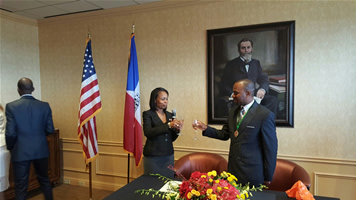
I looked on in admiration as Ambassador Martin Andjaba strolled into the room fresh off a plane from the embassy in Washington, D.C. A wide smile crossed my face when Windhoek Mayor Muesee Kazapua reached out and shook my hand. And I couldn’t have felt more proud as I watched my Mayor, Ivy Taylor, sit at a table and sign the friendship agreement. Watching this historic event triggered thoughts of the great Pan African advocate, Dr. W. E. B. Du Bois, when he wrote about the Diaspora. He described it as the movement of African people over the centuries by force to all parts of the world. He made it quite clear that our homeland would always be Africa even though we have adjusted to a second homeland out of necessity.
Namibia achieved independence from a South African administration in 1990 and has done quite well in building a strong and vibrant Republic. It borders Angola in the north, South Africa in the south, Botswana in the east and the South Atlantic Ocean in the west. It is obviously in this vicinity that many of our ancestors were forced to leave their homeland. My creative mind then took liberties to imagine that, centuries past, the two mayors’ families may have known each other, and just possibly my ancestors and those of the ambassador crossed paths. For that matter, all the African Americans at the event could feel some connection with the many Africans in the room also experiencing this momentous occasion.
 Dr. Du Bois would have been pleased if he could have witnessed the dynamics; it was the Diaspora at work, just like the great thinker would have imagined it. There, at the table was an African mayor from the major city in the Republic of Namibia, sitting next to an African American mayor of the seventh largest city in the United States and the second largest in the State of Texas; both signing an agreement that their respective cities will promote trade and economic cooperation in areas that include renewable energy, health services, biotech, culture and tourism.
I was able to grab the two city leaders’ attention long enough to take a picture with them. I was also able to corral the Ambassador and get one with him. I have to admit I am not a big fan of taking pictures with cell phones, but at that particular time, I sure was glad to know that my wife was an expert at using the cell phone to record history.

I am immensely grateful to my Mayor for inviting me to this event and to the African delegation for coming all the way from Namibia. I am also grateful to the Ambassador for flying from Washington, D.C., to help make this happen and to my wife for providing me with proof whenever I look at the pictures that this indeed really did happen, and I was not just dreaming of a better world.

 thewriterfred