
As we prepare to enter the next ten years, the decade of 2020, I wonder, as a race of people, will we be as successful as Black Americans of the 1920’s. Despite the tremendous number of obstacles placed in their way by a racist country (yes racism existed in all parts of the country and not just the south) these brave and committed Americans stressed the importance of excellence in all fields of endeavor. Two periods in two distinctly separate sections of the country during that illustrious decade are exemplary of that success.
By the year 1921, Black Americans had constructed the most successful business community in the country. As early as 1908, two Black men, J. B. Stradford and O. W. Gurley put their heads together and planned how to keep the money,  Black workers made for working in the oil fields outside of Tulsa and the rich white homes of the successful oil barons, within the Black community. As the oil fields prospered and more Blacks made their way to Tulsa, Stradford and Gurley built living accommodations and assisted other men and women in opening business to serve the needs of the community. Greenwood Avenue became the most prosperous Black community in the country and when visiting it, Booker T. Washington was so impressed he named it “Negro Wall Street” (later changed to “Black Wall Street”).

The golden jewel of Black Wall Street was the Stradford Hotel owned by J.B. Stradford. It was a luxurious 54 room hotel with chandeliers in the ballroom. It was considered the best hotel owned by a Black man in the country and rivaled the white hotels throughout Oklahoma for comfort and accommodations. Across the street and down a couple blocks was the Gurley Hotel, not quite as luxurious as the Stradford but nice enough for Dr. W. E. B. Du Bois to stay there when he visited Black Wall Street in March of 1921. Stradford and Gurley were the two richest Black men in Tulsa.
Not far behind them in wealth were John and Loula Williams. They owned three businesses. The initial business was a car repair service and John was so competent that the whites brought their vehicles to him. They owned the Williams 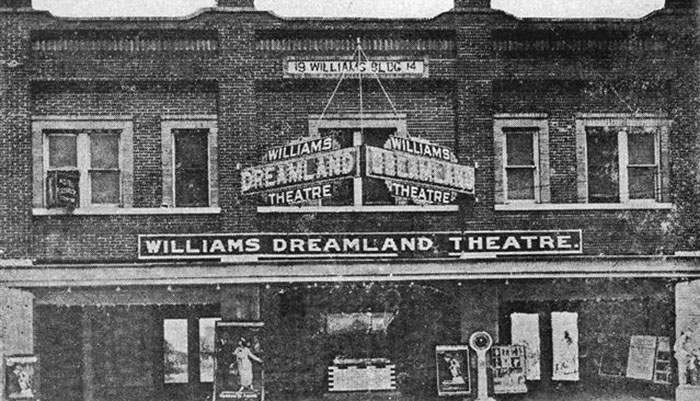 Confectionery right at the corner of Greenwood and Archer. It was the most popular gathering place for the young, and it was believed that more engagements happened there than anywhere else in the community. The Williams also owned the 700 seat Dreamland Theater so that Blacks did not have to endure the embarrassment when attending white theaters, where they were restricted to the balcony and usually had to go through side or back doors. They proudly featured movies also by Black director, Oscar Micheaux.
Mabel and Pressley Little were another very successful business couple. Mabel Little’s Little Rose Beauty Shop was always crowded on Thursday afternoons when the maids got off early and hurried to her shop to get their hair done for Maid’s Night Out, because Friday was their day off. Saturday was her busy day as the older women came in to get their hair done for Sunday morning at church. They owned the Little Bell Café, run by Pressley, with their specialty of smothered chicken.
The World War I Veteran O. B. Mann and his brother, McKinley, owned the Mann Grocery Store, not on Greenwood Avenue but only a couple blocks away on Lansing. It was where most Blacks shopped for their everyday grocery needs. O. B. Mann was one of the real heroes when on June 1, 1921 whites invaded the Black community. He and J. B. Stradford, John Williams and the other veterans of World War I fought valiantly against the invaders and kept them at bay until the airplanes came.
 There were many additional successful Black professionals in the most successful Black community in this country’s history. Dr. A. C. Jackson was recognized as the outstanding Black surgeon in the country. Dr. R. T. Bridgewater ran Frissell Memorial Hospital. There was Andrew Smitherman, the publisher and editor of the militant Tulsa Tribune, with the heading blasted all over the front page of his paper, “You Push Me and I Push You,” and Attorney B. C. Franklin, father of the renowned historian Dr. John Hope Franklin, had his law office right on Greenwood Avenue in the center of Black Wall Street. In fact, there was a total of 196 Black successful businesses on Black Wall Street until the entire community was invaded by a white racist mob driven by hate and jealousy.

If this is a subject that interests you, I invite you to purchase my historical novel, Fires of Greenwood: The Tulsa Riot of 1921, through the publisher, prosperitypublications.com or on Amazon.com for a much more detailed coverage of Black Wall Street and the invasion that ultimately destroyed it.
Accompanying the success of Blac k Wall Street in Tulsa, Oklahoma was the success of Black writers, sculptors, artists and musicians in New York City’s Harlem. During the 1920’s a cultural revolution, referred to as the Harlem Renaissance, began (some scholars argue that it began with the publication of Jean Toomer’s novel Cane in 1921 and others argue it was March 1924 when Charles Johnson and “Opportunity Magazine,” sponsored the Civic Club Dinner, a gathering of White publishers and editors, literary critics, Black intellectuals and young Black writers).
 With the advent of the Renaissance, Black artists, writing in all genres, made their way to Harlem. Langston Hughes, Arna Bontemps, Wallace Thurman and Zora Neale Hurston were among the younger writers who came to Harlem. Additional authors who made their way to the hub of literary activity were Claude McKay (who spent most of the period out of the
 United States, specifically in the Soviet Union), Jessie Fauset, Rudolph Fisher and Nella Larsen. The more established writers already there in Harlem included Dr. W. E. B. Du Bois and James Weldon Johnson. The poet Countee Cullen was born and raised in Harlem. Roland Hayes,
  Paul Robeson, Ethel Waters and Bessie Smith were among the singers. Josephine Baker, Florence Mills and Bill Bojangles were also performers. Duke Ellington’s career took off in Harlem at the Cotton Club. Dr. Alain Locke, a Harvard graduate and the first Black Rhodes Scholar was known as the father of the Harlem Renaissance. A’Lelia Walker, daughter of Madame C. J. Walker was known as the queen of the Harlem Renaissance.
There has never been such an accumulation of Black talent in one place since the 1920’s. The Renaissance lasted only a short period of time and began its decline with the depression of 1929, and with Langston Hughes, James Weldon Johnson and others leaving Harlem. But during the time it was “In Vogue,” it captured the attention of all New York and throughout the country and left its indelible accomplishments that remain with us today.
If this subject interest you also, look forward to my novel, Making My Way to Harlem, to be released in Summer 2020.
As we enter this new decade one hundred years later, the question we must consider can we repeat the success of the 1920’s and accomplish in business, economics and the arts what our ancestors did in the past and left a legacy for us to emulate in the present.


 thewriterfred