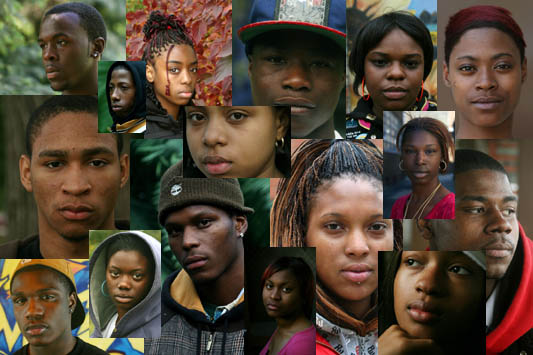
Image Credit: The New York Times | kristof.blogs.nytimes.com
The central city communities predominantly occupied by African Americans are under an outright siege. Gunfire, death and destruction dominate the streets, and law-abiding residents are fearful for their lives. However, in no way is the attack from outside invaders. The perpetrators live within the communities being terrorized on a daily basis. If that is not strange enough, the terrorists are the young men and, to a certain extent, women who escape the reality of their existence by joining gangs.
In many ways they are similar to the 19th Century outlaw gangs that ruled the wild wild west. Much like the Dalton Gang, Billy the Kid and others from the past, these young people view themselves as outcasts, un-welcome intruders in a country they believe does not belong to them. They outright reject American principles and values as being hypocritical, and they view education as a useless endeavor. These young marauders perceive the police as their enemy, and their leaders as self-indulging charlatans only interested in their own economic well being, gained on the backs of the oppressed and down trodden.
Often their heroes are the brothers who have been locked up in the past or are doing time because they defied the system, and are willing to pay the price for that defiance. These young men. who have no problem pulling the trigger and taking a life, choose to take their chances for survival by joining forces with others who believe as they do. Their outlook on life is both hedonistic and pessimistic, and that is an explosive combination for self-destruction.
It must be noted, however, that our young men did not get this way without our participation. And that participation is not of a positive nature. We have brought them into an absolute dysfunctional living environment. From their birth, pathological cultural institutions to include the family, the schools, their music, and even the church surround them. Positive images are usually missing in their lives. They often grow up in an environment of drugs, sex and crime. Usually the music they hear is not about love but sex, the images they see are of entertainers with tattoos on their face and all over their body, pants down below the waist and gold chains around their neck. Their life’s motto is to get what they can right now because tomorrow is not promised to them. And this becomes especially true when they attend the funerals of their young friends who have taken a bullet for the cause.
What all this reveals, is that we need to analyze what got us to this point and then consider a new paradigm different from the past. The great historian, Dr. John Hope Franklin, advised us that if you have a problem, look to the past for the source and then you can deal with it. We need no longer to bemoan our situation, but come up with new ideas and relevant approaches to turn this situation around. And it starts with the adults facing the fact that we have failed our young, and now need to find ways to rectify that failure.
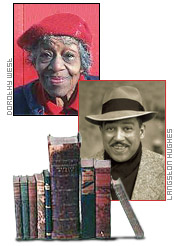
Images: Dorothy West and Langston Hughes | Photo By www.infoplease.com
In the June 1941, issue of Crisis Magazine, Langston Hughes asked the question, “Where are the Black heroes in our literature?” The greatest of all our cultural icons was alluding to the failure of Black writers to create heroes in their works. Hughes went on in that article to elaborate, “Where, in all our books is that compelling flame of spirit and passion that makes a man say, ‘I too am a hero because my race has produced heroes.’”
It is the responsibility of the artist to critique the literature of his or her time, and determine if the writing will serve as a vehicle to uplift the race and perpetuate a positive image of the culture. Hughes obviously was not happy with the images portrayed through novels of his time, to include Bigger Thomas in Native Son. Even though Native Son was an excellent written novel, and no doubt Richard Wright was one of the great artists of his time, it is difficult to view Bigger as anything other than a tragic depiction of the Black male.
The question then is why have Black writers failed to create positive images of the male when writing of the Black experience in this country? Dr. W.E.B. Du Bois argued that it was not the fault of Black writers, but the fault of publishers not willing to publish works that portray the strong Black hero. In a speech given at the 1926 National Association for Advancement of Colored People’s national convention he raised the issue, “Suppose the only Negro who survived some centuries hence was the Negro painted by white Americans in the novels and essays they have written. What would people in a hundred years say of Black Americans?” His conclusion was that they would see only weak men and subservient women. Du Bois went on to point out that, “In responding to material portraying positive images of Blacks, the publishers would often say, “It is not interesting to white folks. They want Uncle Toms, Topsies, good darkies and clowns.”
Essentially Black writers were limited in their ability to strike back at the false images painted of Black people and their culture. The only Black writers published were those willing to follow the rules established by the publishing houses. Twenty years later, Zora Neale Hurston observed that publishing companies used their control as a way to dictate the kind of stories from Black writers suitable for publication.
The constant barrage of negative portrayals of Blacks in the ante-bellum south and after the Civil War, right up to the present has had a devastating affect on the race. The irony is that segments of the Black population have internalized these images and now play them out in reality. That is clearly demonstrated through what is termed “Urban Street Fiction”. Much of the literature is nihilistic in theme and holds out no hope for the future. Writers of “Urban Fiction” write about the chaos with no consideration for the human dimension. The plots are built around, “you get yours and I’m going to get mine at any cost.” There is no redeeming value; only an ugly reality feeding into an age-old belief system that Blacks must be contained because of their bestiality. If one reads these novels and internalizes them as a true depiction of the contemporary Black race, they would be inclined to believe the negative stereotypes painted over a hundred years ago. Many of these books are sitting on the library shelves and are available to children of all ages. How then is it possible to inculcate them with a positive and healthy image of their culture, if it is depicted in such a pejorative manner? This is in no way an argument for censorship, but instead a plea for works that counter some of the negative writings.
We are all familiar with the saying, “Our youth are our future.” If then our children are our future, don’t we have an obligation to give them an opportunity to succeed? But how can they possibly succeed if they are surrounded by negativity. Some of the rap music they listen to is negative. The urban fiction they read is negative. Often their home environment is negative, and their peer groups reek of negativity. Then how is it possible for them to ever enjoy a positive experience about who they are?
In that Crisis article, Hughes continued, “We have a need for books and plays that will encourage and inspire our youth, set for them examples and patterns of conduct, move and stir them to be forth-right, strong, clear-thinking and unafraid.” Consistent with Hughes’ advice, we must define ourselves for our children in order to alter the destructive direction in which our culture is going. Ralph Ellison, author of the great American classic, Invisible Man, wrote as early as 1944, “The solution to the problem confronting the Negro will be achieved when he is able to define himself for what he is and what he desires to be.”
Those of us who are committed artists, have a tremendous responsibility to counter these negative portrayals of our race and culture through works that stress positive messages to our youth. Knowledge of one’s heritage and history is key to healthy growth in any culture. If our youth do not know their history, then they really do not know who they are, and therefore are easy prey for those who produce this devastatingly dangerous literature. Again, Hughes addressed this problem, “The negative behaviors and altered mental states of lead characters in literary works (by Black authors) might leave future generations wondering if Black people lacked heroes.” Hughes’ observation in 1941 is still applicable today. A Spanish writer, Mario Vargas Llosa stated, “Literature is the window to view the soul of a people.” If much of our contemporary literature reflects the quality of our culture and our collective soul then, we as writers, have a great deal of work to do. Our overall goal should be to improve on the images of Blacks in literature. Accepting Ralph Ellison’s challenge to define ourselves by telling our stories our way, we can begin to alter the destructive images of our race, and instead accentuate the strength, beauty, and an enduring love generated by our ancestors for decades.

 thewriterfred