COME AND EXPERIENCE THE LITERARY WORLD OF BLACK AMERICA

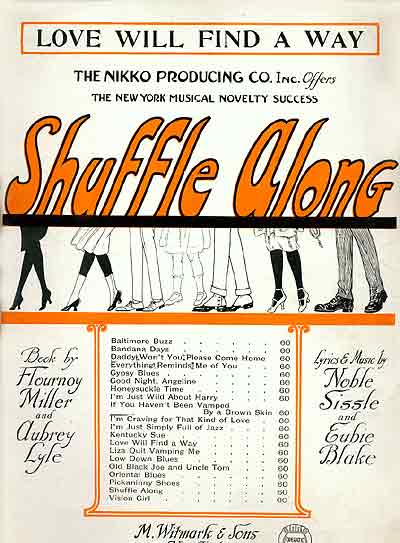
The sheet music for "Love Will Find a Way," one of the hit songs in Shuffle Along. One of the most rarely discussed  | Image Courtesy of: www.musicals101.com
The sheet music for “Love Will Find a Way,” one of the hit songs in Shuffle Along. One of the most rarely discussed | Image Courtesy of: http://www.musicals101.com

A major stimulus to the advent of the Harlem Renaissance was the all Black production of the musical, Shuffle Along. Its debut performance took place on May 23, 1921 in the Cort Theater, located on 63rd Street right outside Harlem. Flourney Miller and Aubrey Lyles, both who got their start performing at Fisk University, teamed with Eubie Blake and Noble Sissle, two celebrated musicians, to write and perform what would become one of the most successful musicals of the 1920’s.

Langston Hughes wrote in his autobiography that it was the magnetism of the show that had him coming back night after night, and led to his decision to enroll in Columbia University so he would be closer to the theater and Harlem. Long after the vibrant cultural activities that dominated Harlem in the 1920’s had waned, Langston still had fond memories of that musical. He wrote in the Big Sea, “But I remember Shuffle Along…because it gave just the proper push—a pre-Charleston kick—,”to what would become the most famous literary period in the life of African Americans.

Shuffle Along became synonymous with the excitement, vibrancy, and exceptional creativity that represented Harlem. The famous cultural historian, Nathan Huggins, wrote of the musical that, “It was like Harlem itself, infectious, it made everyone want to forget his troubles and do it, like the chorus dancers in the clubs.” Shuffle Along opened the era of the Black experience like none other in history. It was, according to Langston, “A period when Charleston preachers opened up shouting churches as sideshows for white tourists. It was when at least one charming colored chorus girl, amber enough to pass for a Latin American, was living in a pent house with all her bills paid by a gentleman whose name was banker’s magic on Wall Street. It was a period of cabarets and extravagant parties given by A’Lelia Walker, the socialite daughter of Madam C. J. Walker. A’Lelia, a grand and statuesque woman was according to Langston, ‘the joy-goddess of Harlem.’ It was a period when every season there was at least one hit Broadway play acted by a Negro cast. And when books by Negro authors were being published with much greater frequency and much more publicity than ever before or since in history…it was the period when the Negro was in vogue.”

Shuffle Along launched the careers of many great entertainers. The great Florence Mills got her start as a singer and dancer in one of the lead roles. The flamboyant Josephine Baker started out as a dresser then earned a place in the chorus line. Paul Robeson also sang with the Four Harmony Kings Quartet in the show, before launching his successful international career as an actor and singer.
Shuffle Along was only one of a myriad of cultural firsts for Black America that emanated in Harlem and spread throughout the entire country and still has a tremendous impact on musicians, artists and writers in the contemporary Black artistic world.

Give the Color Black a Well-Deserved Rest

Every group is the “new Black” | Image By: hatterya.wordpress.com

In his analytical study, The Ideologies of African American Literature, Dr. Robert Washington asserts that, “In preindustrial structures of domination, the ruling group typically controls not only the subordinate group’s economic and political life, but also its cultural representations—namely the ideas and images inscribing its social identity in the public arena. In this country that ruling group has always been white Americans and the primary subordinate group has been Blacks.

Washington goes on to explain that in this relationship the dominant group defines what symbols, expressions and meanings are representative of the subordinate group. These representations emanate from the dominant group’s ideological biases toward the others. Words and expressions have historically been manifestations of those biases. Black is the only color defined in dictionaries by the use of negative adjectives. For example in the American Heritage Dictionary, black is equated with evil, wicked, dirty, soiled as from soot, depressing, angry, gloomy and sullen. It is quite evident that the intent was to create a negative and destructive image of the color black and all objects and persons associated with it. Conversely, the color white is associated with perfect human beauty, especially female beauty.

Historian Dr. Winthrop D. Jordan exposed the manner in which the two colors have been juxtaposed throughout history. He wrote in his award winning book, White Over Black, “No two colors implied opposition as white and black. White and black connoted purity and filthiness, virginity and sin, virtue and baseness, beauty and ugliness, beneficence and evil, and God and the devil. These identifications are necessary in order for whites to justify their historically misguided belief in the inferiority of the Black race to them. Over decades, anything or anyone considered black was viewed negatively. Even African Americans did not want to be associated with their color. Skin lighteners, hair straighten formulas were very fashionable.

The term experienced a brief reprieve during the Black Arts Movement when both writers and musicians made black a term of endearment. Maya Angelou glorified the word black in her poem Phenomenal Woman, Stokely Carmichael gave it strength with his cry “Black Power,” and James Brown sang of black pride with “Say it Loud, I’m Black and I’m Proud.”

But the reprieve was short lived and the color black is once again equated with negative images and connotations. kYmberly Keeton, a brilliant, talented, artistic young sister believes the term slipped back into darkness at the turn of the century. Ten years later with the release of Helena Andrews’ memoirs, Bitch is the New Black, and three years after her book, with the Netflix series, Orange is the New Black, the color was again under severe attack.

I personally take a great deal of pride in referring to myself as a Black man. I am blessed to have been born into a Black family and to be the descendant of great Black men and women who survived an abusive and sick system of exploitation. They made it up the rough side of the mountain, and left us with a legacy of strength, beauty and love. There is nothing negative or hateful about them at all.

I reject the suggestion that bitch and Black women are synonymous. My wife, sisters and my daughters are not bitches nor are the millions of other beautiful Black women who take pride in their race and color.  And the insinuation that prison life is somehow a part of Black life is blatantly false. There are approximately one million Black men and women locked up (which I agree is far too many) out of a total population of thirty million. Three percent is not a fair representation of the Black race. If these writers must equate a color to a negative definition and meaning, why not title their works as Bitch is the New White, and Orange is the New White and give black a well-deserved rest.