
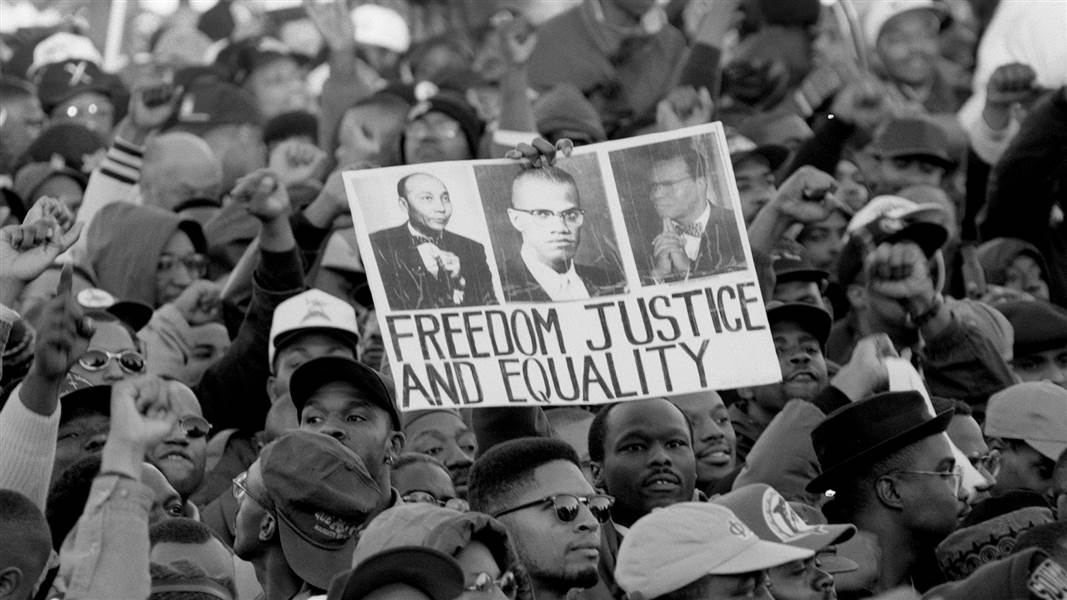
It appears that one of the major goals coming out of the recent Million Man March, labeled “Equal Justice or Else,” was a call for Black America to boycott Black Friday and every shopping day throughout the entire Christmas season. This appears to be another attempt by Minister Louis Farrakhan and his followers to eradicate the celebration as part of the African American culture in this country. I watched and listened to one of the minister’s attacks on the manner in which most Black Americans celebrate the season. In his peroration, he claimed that Dr. Martin Luther King Jr., wanted to boycott Christmas after the killing of the four little girls in the Sixteenth Street Baptist Church Bombing in September 1963, in Birmingham, Alabama. He then made the appeal for all us to boycott this year’s Christmas shopping season in the name of Dr. King. “I’m going to ask us in his name (King) to do something he wanted to do when they bombed the four little girls…he wanted to boycott Christmas.”
For a very long time I did a great deal of research on Dr. King for a course I taught on African American Political Thought at the University of Texas in San Antonio, and I never remember reading from any credible source where it is mentioned that he wanted to boycott Christmas. Since Dr. King was a Baptist minister, who sincerely believed in the teachings of Jesus Christ, I found it rather interesting that the minister made this assertion. Now I am sure that the minister would not make such a claim just to complement his call for a boycott, so if there is anyone who reads this post and can direct me to the passage where Dr. King called for the boycott, I would appreciate receiving it.
 In his speech, Minister Farrakhan continued to disparage those millions of African Americans who are Christians because of the manner in which they celebrate Christmas. According to him, the tradition of displaying a Christmas tree in your home with decorations is comparable to “practicing paganism.” He quoted from the Tenth Chapter of “Jeremiah” as evidence of his accusation. He then referred to gifts that families and friends exchange as foolishness. He claimed that we pay more respect to the “Big fat Caucasian who flies out of the North Pole with a bag full of gifts, and is supposed to come down a chimney that most homes don’t have, than we do to Christ.” The thrust of his message was that we spend money on gifts that leave us in the red after the holiday season, while the merchants make enough money to last them throughout the year.
He then talked about the amount of liquor and dope that is consumed during the holiday. Again, he accused us of placing more importance on the dope and booze than on Jesus. That makes us, according to Minister Farrakhan, part of a heathen and pagan practice.
I guess my question to Minister Farrakhan would be, is this kind of attack on his fellow Black brothers and sisters really necessary? I’m not sure whom he is referring to, but the friends and associates I know consume very little, if any at all, liquor and no drugs. I imagine there are thousands of Black families that celebrate the holiday and consume no booze or drugs.
My family, as is the case with thousands of other Black families, has a tradition of placing a Christmas tree in our home and I really do not appreciate anyone, Black or white, referring to me and all my brothers and sisters who do the same as heathens and pagans. I believe our race has suffered sufficient name calling over the decades that we don’t deserve it from one who considers himself a leader.
Finally, there are millions of beautiful Black Americans throughout the decades who have turned to Jesus Christ for sustenance and salvation, and their worship of Him is real and necessary for them. Throughout the turbulent years of apartheid, mothers turned to the church and their minister when their husband was lynched or their daughters raped. The minister, in the name of Christ, provided them with the strength to make it through those terrible times. The Christian church has been the pillar of strength for our race since emancipation. The church continues to play that role. So the gifts bought at Christmas are not foolishness, it is symbolic of the love that our people feel toward Christ. It is the giving of the gift that counts, and for that reason it is not foolishness.
If Minister Farrakhan doesn’t believe in celebrating Christmas and doesn’t indulge in gift exchange, we as Christians have no problem with that position. And if the followers of the Nation of Islam want to celebrate Founder’s Day when they pay deference and respect to those held in high regard, we as Christians will wish them well. However, I think it is quite appropriate that we expect the same kind of respect from the Nation when we celebrate Christmas in the manner we choose.


 thewriterfred