Making History in the United States Senate

Image Courtesy of www.shmoop.com
The First Colored Senator and Represenatives | Image Courtesy of http://www.shmoop.com

Every year at this time, a heavy dose of nostalgia sets in and I recall my most memorable experience, while working on Capitol Hill as a Legislative Aide to Senator Birch Bayh from Indiana. It was in the winter of 1978, when the Senator and I attended a meeting in the office of the late and great Senator Ted Kennedy.

When we strolled into his spacious office, the first person I saw was Coretta Scott King sitting on the couch, next to Congressman John Conyers from Detroit, Michigan. My friend Peter Parham, a Legislative Aide to Kennedy, was also present. Peter and I had grown close because we worked for two of the most liberal senators, who often championed legislation important to the Black community. We also lived in the same apartment complex in Northwest Washington, and everyday would share a ride to Capitol Hill. As I sat down in one of the chairs close to Mrs. King, I knew that I was about to be a part of making history that day.

Mrs. King got right to the point and asked the two Senators to introduce a bill in the Senate Judiciary Committee, to make her husband’s birthday a national holiday. Ever since the assassination of Dr. Martin Luther King, Jr., Congressman Conyers had contemplated introducing similar legislation in the House of Representatives. Without hesitating, Kennedy and Bayh agreed to be the sponsors of the bill. Soon after, the late Senator Edward Brooke and Senator John Glenn joined in as sponsors. Ralph Neas from Brooke’s staff and the late Reginald Gilliam from Glenn’s office joined our team, and we would often strategize on the best way for our bosses to proceed with the bill. Peter and I had the primary responsibility for organizing the hearing that would last for two days, in the Judiciary Committee Room of the Russell Senate Office Building. That, also, might be a part of history; two Black staffers in the United State Senate, responsible for initiating the first Senatorial hearing to make the first Black American’s birthday a national holiday.

I will always remember the venerable Clarence Mitchell, who ran the NAACP’s Washington, D.C. Office and was known as the 101st Senator, testifying before the committee. With immense pride exuding from each word he spoke, the great strategist praised Kennedy and Bayh; “When I see young Black men and women sitting up there next to you Senators, and when I see them on the Senate floor where important public policy issues are being debated, in the greatest deliberative body in the world, I know we have made great progress in the country.”

Today if you attend hearings on the Hill, it is routine to see Black staffers representing Senators and Congresspersons. Back in 1978 it was the exception to the rule. Peter and I were in that first wave of Black men and women to be appointed to the staffs of Senators, in key legislative positions. There were about ten of us, and we all have gone on to pursue our own careers. But I am certain that when those staffers, who assisted the two of us in structuring that initial hearing, celebrate the holiday their memories will be as vivid and enduring as mine.
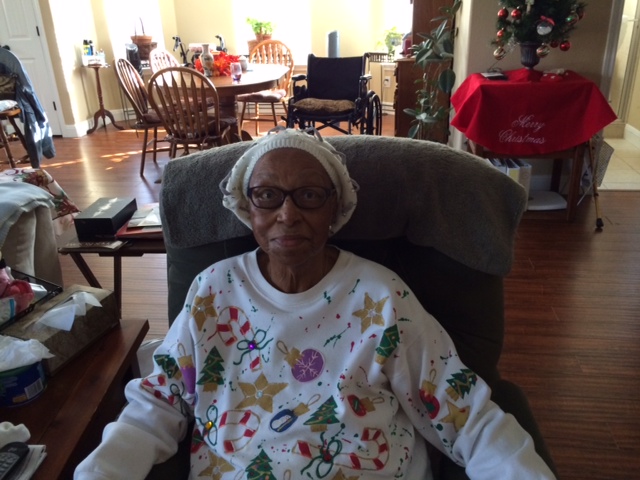
A CHRISTMAS GIFT FOR THE MOTHERS

Willie Mae Williams, at home in Bastrop, Texas.
Willie Mae Williams at home, in Bastrop, Texas. 

Willa Mae Williams just had a hip replacement on this past Monday and by Friday she was up and walking. What makes this worth writing about is that Willa Mae is 94 years old, and she has no plans of slowing down once she completes her rehabilitation.

Born in 1920 in a small southern town in Arkansas, Willa Mae was part of that great migration of Black Americans who left the South during the early part of the Twentieth Century and moved North, seeking better opportunities and escaping from the ugliest aspect of American racism. She arrived in Saginaw, Michigan in 1933 and by 1937 had married Bill Williams, who was five years older. Their union was a synthesis of the traditional southern culture with the emerging northern culture. She was 17 when she married her husband and 76 when he passed away. Willa Mae dedicated her entire life to her husband and to raising her family.

Willa Mae’s mother, Lucy Perry, at the age of 39 lost her husband to tuberculosis one month before giving birth to her youngest son. At the time she had two teenage boys, one teenage daughter and a baby still at home. Despite the tremendous hardship she confronted, Ms. Lucy raised her sons and daughter by herself. Nina Williams, Willa Mae’s mother-in-law, married George Williams in 1912 and stayed married to him until his death in 1962. She gave birth to five boys and three girls and dedicated her life to raising her family, also.

Willa Mae Williams, Lucy Perry and Nina Williams are no different than millions of beautiful Black women who, over the decades, have dedicated their lives to the family. They have been the glue that has held our culture together. These three Black women are the ones that took time to raise my brother, two sisters and me. I am sure that all my readers have similar mothers and grandmothers that assisted them in the navigation through this life. Oftentimes their biggest fears would be that their children would face a hostile environment and respond to it in a negative way. And that negativity could get them locked up or killed.

The burden of mediating with their children to keep them out of harm’s way, has weighed heavily on the Black mother from slavery to the present day. Often times slave mothers would prefer to whip their children than to have the overseer or oppressor do it. Leon Litwack in his historical work, Trouble In Mind, writes that, “During slavery parents were helpless to protect their children from a whipping and they were sometimes compelled to inflict the punishment themselves in the presence of whites to teach the disobedient child a lesson—and to avert even harsher punishment if meted out by the overseer or owner.” (Leon Litwack, Trouble In Mind, Vintage Books, New York, 1999, pg. 25)

After Emancipation, the problems increased because a generation of young Blacks born into freedom never accepted the rules of segregation and often rebelled against them. Black mothers again took on the burden of explaining to their young why they could not talk back to a white person or fight with a white boy, even if they were attacked. This often caused a great deal of conflict between the mothers and their children.

But through it all, the Black mother never lost her grace and dignity. She brought us up the rough side of the mountain and made it possible for her children to prosper and succeed in life, despite all the inequalities of this society. For that reason, I suggest that during this season of giving, we all give the greatest gift possible to our mothers, grandmothers and in some cases great grandmothers, and that is the gift of love. That would mean so much to them, who have given so much for us. Despite all the hardships, suffering and pain, if they can only hear four ingratiating words from their children, it will make all of it worth while and those words are, “I LOVE YOU, MOTHER.’”